Saturday, March 6, 2010
Idea #10 - 3.4.10 - Back to color fields
While thinking of ways to present my work, keep coming back to a sort of color field approach to my image arrangement. The way that I am working is similar to color field painters in that there is a great importance in relationships between colors, image qualities, space, and size, but instead of working in one canvas, I will be composing installations of multiple images. I am imagining each instrument as having it's own image and then arranging them in accordance to their presence in the song. I will be kind of mapping out a song like I've always been doing, but now I feel like instead of presenting everything in a song in one image, I am more free to explore how different elements can interweave with one another. The images will be composed based on the feeling of an instrument, like a trumpet would be an image of something bright, tight, sharp and exciting. If it is a trumpet solo, or the trumpet is the prominent instrument in the song, the image may be big or may span the whole composition, but maybe the trumpet just adds little accents throughout the song; then there might be multiples of the same image and would be small and placed throughout as visual accents to other images. Rhythm is important but may not stay exact to the song, instead it will be built based on an overall rhythm in a song, not on individual beats as my work was before.

Wednesday, March 3, 2010
Artist #9 - 3.1.10 - John Baldessari
One of the artists Paul told me to look at in our first meeting was John Baldessari. Some of his work I do not get at all, but some of it I think is awesome. The stuff' that first struck me was his text work like these:
 John Baldessari (b. 1931)
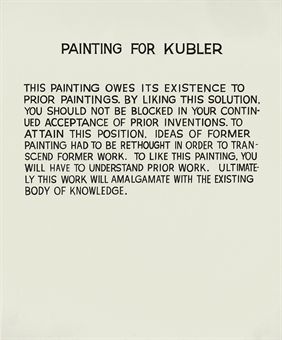 John Baldessari (b. 1931)
 Painting for Kubler
acrylic on canvas
67 7/8 x 56½ in. (172.4 x 143.5 cm.)
Painted in 1966-1968.


John Baldessari
Everything is Purged...
1966-68
68 x 56 in.
acrylic on canvas
67 7/8 x 56½ in. (172.4 x 143.5 cm.)
Painted in 1966-1968.
John Baldessari, Solving Each Problem as It Arises

John Baldessari
Everything is Purged...
1966-68
68 x 56 in.
What I like about this work is that it is talking about art, it is causing the artist to consider the paradigm that he exists in. My favorite one is Painting for Kubler because I see it as applying to aspects of society other than art. Things like our economic system, art, or even culture are entities on their own. We know nothing outside of them. I feel like they could all be compared to a strange, ancient flying machine that we pushed off a cliff, we only think we're flying because we haven't hit the ground yet. This piece suggests that there are other paths that art (or economics or culture) could have taken, but after it got going in this direction, that is all there could be. If it were all to crumble, what would the next attempt look like? Surely a totally different paradigm.
In "Solving Each Problem as It Arises" I thought it was interesting how he ends it. I think this points at an important flaw in art; how people who aren't artists view art. This piece might not even be about that, but it makes me think about how a normal person, who doesn't know much about art can interpret some of the stuff artists make. As artists are we making art for each other(other artists), or for everyone?
Some of his other work is inaccessible to me, pieces like this for example,
 Yves Saint Laurent Shirt
John Baldessari
In "Solving Each Problem as It Arises" I thought it was interesting how he ends it. I think this points at an important flaw in art; how people who aren't artists view art. This piece might not even be about that, but it makes me think about how a normal person, who doesn't know much about art can interpret some of the stuff artists make. As artists are we making art for each other(other artists), or for everyone?
Some of his other work is inaccessible to me, pieces like this for example,
 Yves Saint Laurent Shirt
John Baldessari
Is this of a religious nature? Is it about temptation? What is the significance of the painted-over faces with grayscale noses and ears? The title references the shirt, but it doesn't seem to be about the shirt at all, is it about consumerism? Is this supposed to be some kind of modern portrait of adam and eve? This stuff seems to be his most popular work, but it doesn't speak the same way other stuff of his does.
Thursday, February 25, 2010
Idea #8 - 2.25.10 - A Few Ideas
For this idea post, I wanted to put down some ideas I've been thinking about.
1. This one might be too crazy and inaccessible because I think it has the problem of utilizing a made-up language, which I guess is like what I was doing before. Another problem is that it brings me away from photography and more into sculpture. Here it is anyway... When I hear music I often find different instruments or melodies to have textures, sizes, or some dimension or quality about them that brings a feeling, when I try to identify these feelings words like silky, tight, or wet are what come to mind, among others. For example, a bassline can be hammocking a chunky guitar with a sticky drum. When I hear this song I dont imagine a hammock filled with peanut butter but when I try to rationalize the words for the feelings that each part gives me, that is what comes to mind. What I love about this idea is the abstractness and absurdness of it. A problem that I am having with using imagery is that I feel a pressure to have actual 'things' in my photos, which feels at odds with instrumental music, and in this case, I feel like the quality of the materials would be important and would be lost in a photo.
2. In an attempt to make it more about photography, I thought to try shooting photos with long shutter speeds while making a sound recording of that same moment. It seems interesting to me but I'm struggling with what meaning it has. What is the implication of the image being still? Make it moving and it is a video. Is it a statement on the nature of photography? Is it about time? A photograph can contain a moment in time, whether a fraction of a second or 30 minutes but no matter how long, it can be experienced instantly. Sound can only be depicted through time, or in a visual representation which is then essentially a photograph which could not be identified by anything other than 'a sound wave' by a viewer. Perhaps in this type of work I would be dealing with ideas about how accurately a photograph can portray life. I'm not sure, I dont know if this is a good idea either.
3. I imagined something more interactive that deals with the same stuff I've been working with. I thought about fashioning a keyboard that lights up and is basically a manifestation of the color/music theory I've developed. The viewer immediately sees how the colors of the rainbow are related to the keyboard, so if they were to play a set of complimentary colors they hear it as harmonious. In theory, someone who is really in touch with color relationships might be able to play the piano beatifly without knowing anything about music, but by simply choosing key combinations based on their colors.
I like this idea the most, however, I imagine a slew of technical aspects that might make it impossible. It also isn't photography. For some reason I can't seem to develop ideas that stay exclusively in the realm of photography. All of these still are incorporating music or sound in some way but for a lot of reasons I feel like should try to not even use sound or music at all. But how can I express the ideas I'm working with, without the element of sound? Can I make photography that truely has the experience of music? I don't know, I've gotten myself pretty confused at this point.
1. This one might be too crazy and inaccessible because I think it has the problem of utilizing a made-up language, which I guess is like what I was doing before. Another problem is that it brings me away from photography and more into sculpture. Here it is anyway... When I hear music I often find different instruments or melodies to have textures, sizes, or some dimension or quality about them that brings a feeling, when I try to identify these feelings words like silky, tight, or wet are what come to mind, among others. For example, a bassline can be hammocking a chunky guitar with a sticky drum. When I hear this song I dont imagine a hammock filled with peanut butter but when I try to rationalize the words for the feelings that each part gives me, that is what comes to mind. What I love about this idea is the abstractness and absurdness of it. A problem that I am having with using imagery is that I feel a pressure to have actual 'things' in my photos, which feels at odds with instrumental music, and in this case, I feel like the quality of the materials would be important and would be lost in a photo.
2. In an attempt to make it more about photography, I thought to try shooting photos with long shutter speeds while making a sound recording of that same moment. It seems interesting to me but I'm struggling with what meaning it has. What is the implication of the image being still? Make it moving and it is a video. Is it a statement on the nature of photography? Is it about time? A photograph can contain a moment in time, whether a fraction of a second or 30 minutes but no matter how long, it can be experienced instantly. Sound can only be depicted through time, or in a visual representation which is then essentially a photograph which could not be identified by anything other than 'a sound wave' by a viewer. Perhaps in this type of work I would be dealing with ideas about how accurately a photograph can portray life. I'm not sure, I dont know if this is a good idea either.
3. I imagined something more interactive that deals with the same stuff I've been working with. I thought about fashioning a keyboard that lights up and is basically a manifestation of the color/music theory I've developed. The viewer immediately sees how the colors of the rainbow are related to the keyboard, so if they were to play a set of complimentary colors they hear it as harmonious. In theory, someone who is really in touch with color relationships might be able to play the piano beatifly without knowing anything about music, but by simply choosing key combinations based on their colors.
I like this idea the most, however, I imagine a slew of technical aspects that might make it impossible. It also isn't photography. For some reason I can't seem to develop ideas that stay exclusively in the realm of photography. All of these still are incorporating music or sound in some way but for a lot of reasons I feel like should try to not even use sound or music at all. But how can I express the ideas I'm working with, without the element of sound? Can I make photography that truely has the experience of music? I don't know, I've gotten myself pretty confused at this point.
Monday, February 22, 2010
Artist #7 - 2.22.10 - Christian Marclay
During our meeting, Paul suggested I look at Christian Marclay. He was one of the first people to use turntables as an instrument, independently, but around the same time as hip-hop artists were beginning to do so as well. Most of his work deals with altering or destroying records to produce interesting music loops or soundscapes. My criticism is that he doesn't make music so much as he just makes noise, or "sound collages". I understand that he is an innovator of this sort of thing but my interest ends there. I suppose it's hard for me to grasp why you would want to make music sound bad. Of course this gets into the whole discussion of what 'good' music even is which could be a whole other blog post.
The method of using multiple musical samples to make something new reminds me of a lot of modern music. DJ Girl Talk is someone who is pushing the limits of this method but doing it in a much more musical way than Marclay. He takes parts of numerous hit songs and arranges them in such a way that they continuously and seamlessly play play with and mold into one another. Also on a less notable level, in the recent past it was the standard for hip-hop artists to make beats composed of sliced samples of old records and turntable scratching. Marclay's work reminds me of non-rhythmic hip-hop.
Marclay also does visual work although, like myself, his visual work seems inferior to his audio work(aside from his installations, which I like the most). Here are a few of those,
 Christian Marclay, Stereo Volume, 1989
 Christian Marclay, Guitar Drag, 2000
 Christian Marclay, Ensemble, 2007
 Christian Marclay, Ensemble, 2007
Christian Marclay, Video Quartet, 2002
I found an interview with him where he mentions something that reminds me a lot of myself, in it he says, "Being in art school and wanting to make music was not an obvious choice but I felt a lot more energy coming out of the music world than from the art world. When I was visiting New York on the weekends, I tended to gravitate more towards what was happening in music clubs than towards what was happening in museums and galleries." To be perfectly honest, I have little interest in the art world, but I could spend hours in the basement at Plan 9. It's not that I don't like art, I just don't like what art is these days. So instead of looking for visual artists, I usually spend more time looking for new musical artists. It seems like other artists keep up with artists the way I keep up with musicians, looking for their new work or where they are showing next. I came to school to learn how to be a photographer, not necessarily a fine art photographer. But since that's what I'm doing, I feel like I can use music more expressively as art than I can photography.
The method of using multiple musical samples to make something new reminds me of a lot of modern music. DJ Girl Talk is someone who is pushing the limits of this method but doing it in a much more musical way than Marclay. He takes parts of numerous hit songs and arranges them in such a way that they continuously and seamlessly play play with and mold into one another. Also on a less notable level, in the recent past it was the standard for hip-hop artists to make beats composed of sliced samples of old records and turntable scratching. Marclay's work reminds me of non-rhythmic hip-hop.
Marclay also does visual work although, like myself, his visual work seems inferior to his audio work(aside from his installations, which I like the most). Here are a few of those,
 Christian Marclay, Stereo Volume, 1989
 Christian Marclay, Guitar Drag, 2000
 Christian Marclay, Ensemble, 2007
 Christian Marclay, Ensemble, 2007
Christian Marclay, Video Quartet, 2002
Saturday, February 20, 2010
Idea #6 - 2.18.10 - Tryin to think outside the frame
During my individual meeting with Paul, we discussed how I could bring my photography to have the same impact as my music. He suggested that I try to ignore what I think the rules of photography are and use imagery in any way I can to get the effect I want. Some ideas I have been working with are multiple images that together can created a mood or scenario, not just in their content but in their arrangement, repetition, and colors. However, I am afraid that this language may brush too close to what a movie or music video is. It is still a bit unclear to me as to how I can really build a strong relation to the music in this way without becoming too much like a music video. I think perhaps the difference is that I believe that qualities of music can be captured in still imagery, I just need to find an effective way of communicating this. I also want to toy with how music changes the context of an image. For example an innocent image may become sinister in combination with ominous music, and then may change back to playful with a happier tune or vice-versa. And although I know the language I have created of connecting colors to musical notes seems to be inaccessible, I still want to incorporate it. Griffin suggested that I use a sort of key in my artist statement, which I think would be helpful in understanding my work.
Artist Lecture #1 - 2.16.10 - Hank Willis Thomas
I attended the Hank Willis Thomas lecture and thought that it was good. Particularly his stuff that deals with advertising. I thought it was funny what he said about MasterCard having an ironic name because most of us are in debt to them. His series Br@nded was really cool, and I found it interesting what he said about when he was showing the series people didn't know that they weren't advertisements. It makes me wonder how much people were even paying attention, because although they have the language of advertising, they clearly are 'advertising' a different agenda. My favorite piece was this one,
 I thought it was interesting how he has shown basketball as a means of holding down black people. It seems that the media has convinced many black men that basketball or rap music is their only way to success, limiting their progression in other areas. And something interesting he said was "we came here in chains and now we're still wearing them." And of course, the reason is not as any sort of memorial, but rather a perpetuation of the media's portrayal of black men.
I also thought the works where he removed the text out of magazine ads were very interesting, but I found myself wondering what kind of crazy subliminals he could find if he didn't limit himself to portrayals of black people. I understand that the portrayals of blacks is central to his idea, but it is clear, to me at least, that advertising has always been building and perpetuating some strange TV world of misplaced ideals and skewed interpretations of real life.


 I thought it was interesting how he has shown basketball as a means of holding down black people. It seems that the media has convinced many black men that basketball or rap music is their only way to success, limiting their progression in other areas. And something interesting he said was "we came here in chains and now we're still wearing them." And of course, the reason is not as any sort of memorial, but rather a perpetuation of the media's portrayal of black men.
I also thought the works where he removed the text out of magazine ads were very interesting, but I found myself wondering what kind of crazy subliminals he could find if he didn't limit himself to portrayals of black people. I understand that the portrayals of blacks is central to his idea, but it is clear, to me at least, that advertising has always been building and perpetuating some strange TV world of misplaced ideals and skewed interpretations of real life.

Monday, February 15, 2010
Artist #5 - 2.15.10 - Ciro Totku


Today I want to talk about Ciro Totku. He is a Russian abstract photographer working in Cambodia. Totku finds his images mostly in nature and although I chose him for his use of color, not all his work is in color. His work is similar to the last photographer I talked about, Mark Mason. While looking through his work, I found myself often wishing I had some of these bright colorful images to explore musically. When I shoot I tend to focus on compositional elements, and while I enjoy his compositional sensibilities, his work has inspired me to look more for colors and interesting color relationships. I realized that this is the most important thing I could do considering my work is all about relationships between colors and musical notes. The more complex my color relationships, the more interesting my musical scores could be.
Subscribe to:
Posts (Atom)